Your Vendors' Infrastructure Is Your Attack Surface Too

Kaveh Azarhoosh
Community & Research Lead
Your Vendors' Infrastructure Is Your Attack Surface Too
Security teams spend enormous effort hardening their own systems. They audit their networks, monitor their domains, patch their servers. But the infrastructure that actually supports their operations extends far beyond what they control.
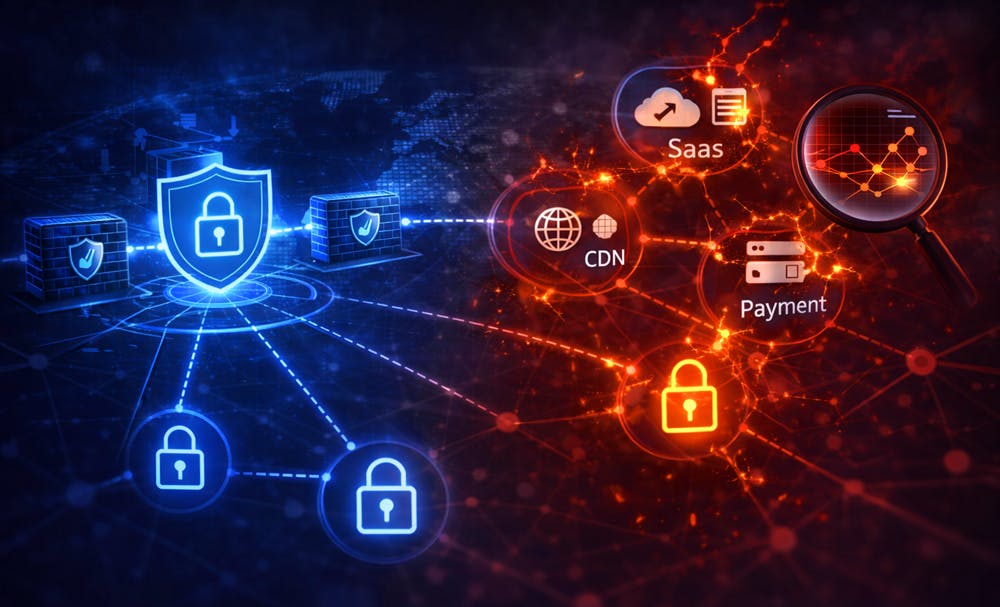
Every SaaS tool your team relies on. Every payment processor embedded in your checkout flow. Every third-party script loaded on your website. Their infrastructure is your infrastructure, whether you can see it or not.
When their domain lapses, their DNS misconfigures, or their hosting provider suffers an outage, the blast radius extends directly to you. And most organizations have no visibility into these dependencies until something breaks.
The risk you can't see
Ask a security team about their own infrastructure and they'll have answers: which domains they own, where they're hosted, who manages their DNS. Ask them where their critical vendors are hosted, whether those vendors share underlying providers, or what happens if a single cloud region goes down, and the picture gets murky.
This isn't negligence. It's a visibility gap.
Third-party risk programmes typically focus on questionnaires, compliance certifications, and contractual obligations. These capture intent, not reality. They don't tell you what's actually under the hood right now. A vendor can pass every security assessment and still create concentration risk if their infrastructure, and the infrastructure of three other vendors you rely on, all resolves to the same autonomous system.
The same logic applies to security threats. Attackers increasingly target the supply chain precisely because it's opaque. Compromising a single vendor can provide access to hundreds of downstream organizations. And the infrastructure patterns that enable these attacks, shared hosting, common DNS providers, overlapping certificate authorities, are invisible to tools that only look at your own perimeter.
Dependencies are graph problems
The challenge is that supply chain infrastructure isn't a list. It's a web of relationships.
Your vendor's application runs on a cloud provider. That provider's DNS is managed by a third party. That third party's infrastructure sits in an autonomous system with its own routing policies and peering relationships. A failure or compromise at any layer can propagate in ways that are difficult to predict from a flat inventory.
Understanding these relationships requires mapping them as a graph, connecting domains to IPs, IPs to ASNs, ASNs to routing behavior, and tracing how your vendors' infrastructure actually interconnects beneath the surface.
This is where traditional vendor risk management falls short. Spreadsheets and questionnaires capture point-in-time snapshots. They don't reveal that your CRM, your email provider, and your analytics platform all depend on the same underlying infrastructure, or that a supplier three layers deep has DNS configurations that mirror known bulletproof hosting patterns. NIST's guidance on Cyber Supply Chain Risk Management emphasizes the need for visibility into these extended dependencies, but most organizations lack the tools to achieve it.
Seeing the extended attack surface
Mapping supply chain infrastructure isn't about distrust. It's about understanding your actual exposure, the infrastructure dependencies that exist whether you've documented them or not.
Whisper extends visibility beyond your own perimeter. We map the infrastructure beneath third-party services, domains, IPs, ASNs, DNS records, BGP routing, and certificates, and surface the hidden dependencies and concentration risks that questionnaires miss.
Your attack surface doesn't stop at the infrastructure you control. Neither should your visibility. Start mapping them today with a free Whisper API key.