Attackers Change Their Domains. They Rarely Change Their Habits.

Kaveh Azarhoosh
Community & Research Lead
Every security team knows the frustration. You detect a malicious domain, add it to your blocklist, share it with your threat intel feed, and by the time the indicator circulates, the attacker has already moved on. The domain is dead. The IP has rotated. The campaign continues from fresh infrastructure.
This is the fundamental problem with reactive threat detection: it's always looking at yesterday's attack.
But here's what attackers cannot easily change: the way they build. Every provisioning decision leaves a trace a kind of digital exhaust that accumulates before a single attack is launched.
Infrastructure leaves fingerprints
When threat actors set up campaign infrastructure, they make choices. Which registrar to use. Which hosting provider. How to configure DNS. What certificate authority to trust. Whether to register domains in bulk or spread them across weeks. These choices are not random, they reflect operational habits, resource constraints, and tradecraft preferences that persist across campaigns.
Changing a domain costs nothing. Changing your entire provisioning workflow, the registrars you trust, the hosting you've tested, the automation you've built, requires re-engineering your operation.
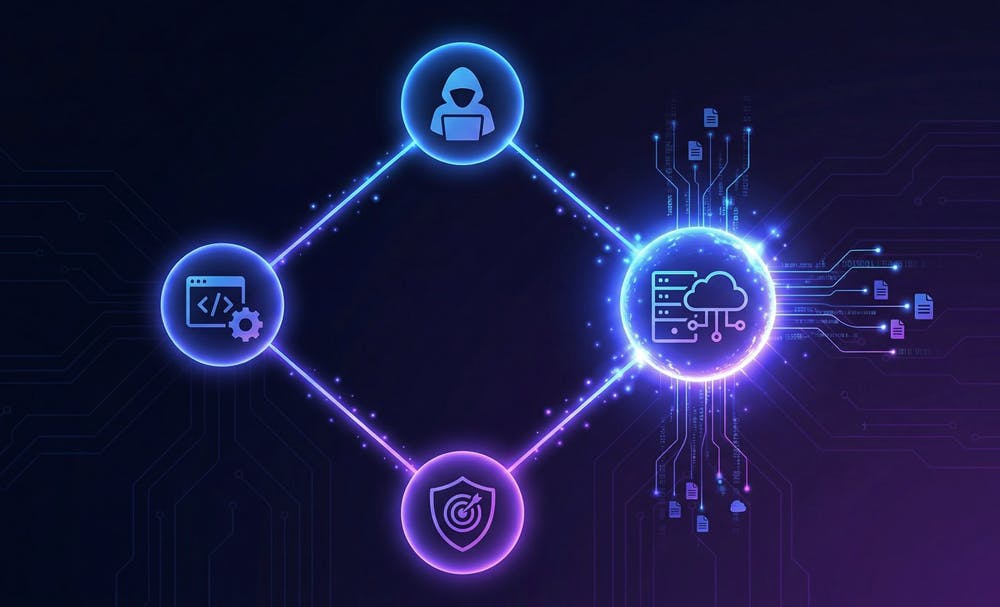
The Diamond Model of Intrusion Analysis formalizes this intuition: every intrusion has four connected vertices adversary, infrastructure, capability, and victim. Analysts can pivot between them. When you map infrastructure patterns, you're not just cataloguing assets, you're following the edges of the diamond to uncover what individual indicators cannot reveal.
Infrastructure fingerprinting operates in this space. It's not about chasing individual domains. It's about recognizing the signature of how an attacker provisions their infrastructure, and using that signature to find related assets before they're weaponized.
What patterns actually look like
Consider how threat actors register domains. Research consistently shows that campaigns often use a single registrar, register domains in clusters around the same timestamp, and favor specific TLDs. Some groups register infrastructure weeks or months before activation, building a "clean" reputation before the first phishing email goes out. Others burn through domains in days, relying on speed rather than stealth.
Hosting choices follow similar logic. Threat actors gravitate toward providers with lax abuse policies, low costs, or jurisdictions that complicate takedowns. Once they find infrastructure that works, they tend to reuse it, or return to the same providers even after being disrupted.
Certificate behavior is revealing too. Techniques like [JARM fingerprinting](https://ieeexplore.ieee.org/document/10218210), which hashes a server's TLS responses, can identify clusters of command-and-control servers running identical configurations, servers that, individually, would appear unrelated.
Routing behavior matters too. Attackers often host infrastructure in bulletproof ASNs known for ignoring abuse complaints, or exploit hijacked IP prefixes to obscure attribution. These BGP-level signals are invisible to tools that stop at the domain layer.
None of these signals is definitive on its own. But when you connect them, registrar, timing, hosting, DNS configuration, certificate patterns, you start to see infrastructure as a network of relationships rather than a list of isolated indicators.
From indicators to relationships
This is where traditional threat intelligence falls short. Most tools treat each data point in isolation: a domain, an IP, a certificate. But attackers don't build infrastructure in isolation. Every certificate references a domain, every domain resolves to an IP, every IP sits on a network. The connections between these elements carry information that the elements themselves cannot reveal.
Mapping those connections is a graph problem, one that requires unifying data sources most tools treat separately. It's the problem Whisper was built to solve.
We bring together domains, IPs, ASNs, DNS records, WHOIS data, and certificates into a single queryable graph. Instead of asking "is this domain bad?" you can ask "what else shares infrastructure with this domain?" and follow the thread to assets that haven't yet appeared on any blocklist.
Infrastructure fingerprints are harder to hide than the attacks themselves. Start mapping them today with a free Whisper API key.